By Camp & Trail Guide
California is bigger than any single park, and this guide covers the state beyond Yosemite, which has its own guide on this site. California holds five of America’s ten most popular hikes on Strava’s April 2025 to May 2026 ranking, it ranks first among US states for hiking in the KURU 2026 ranking cited in the research, with a score of 90.5, and it is described there as the only state with a perfect 25 out of 25 for trail variety, with more than 16,500 trails and nine national parks. The planning story here is variety itself: desert, redwoods, and Sierra mountains in one state, with seasons that invert between them. This is a research-based guide, and every figure below comes from the research source.
Joshua Tree, Redwoods, and Sequoia–Kings Canyon
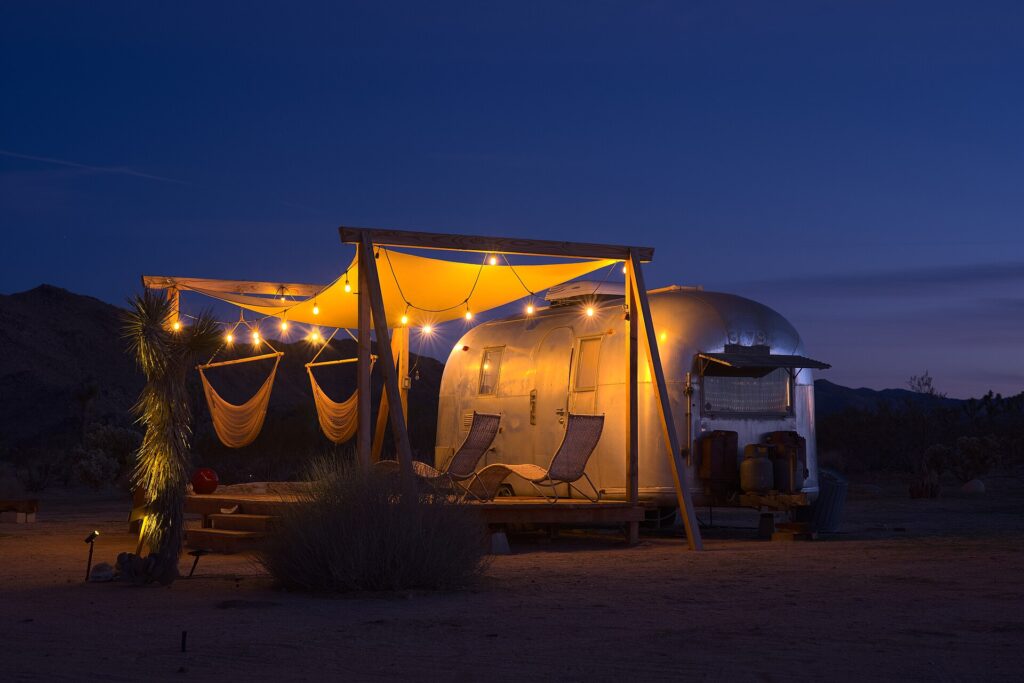
Joshua Tree is California’s desert national park, a winter-strength destination where the desert season runs opposite to the Sierra season. The redwoods, including Jedediah Smith Redwoods, offer a completely different camping experience: tall forest, coastal influence, and shaded campgrounds. Sequoia and Kings Canyon bring the Sierra mountain experience, with giant trees and high-elevation trails. Together, these three areas show why a single California camping rule does not exist. Check each park’s official site for its current campgrounds, fees, reservation windows, and length and hookup limits, because those details differ by park and this guide does not invent a figure the source does not state.
Jedediah Smith Redwoods ranks number four on The Dyrt’s 2026 Top 10 places to camp in the United States, a community signal that puts a California redwoods campground among the country’s best-regarded sites. Mono Hot Springs appears on The Dyrt’s National Park Neighbors list, marking it as an alternative when nearby parks are fully booked. When a popular California campground is full, the neighbor and dispersed options nearby are the realistic plan, not a second attempt at the same sold-out site.
Fees and Reservations
Check the official site for the current fee and booking window for the campground you want. For rough budgeting only, independent cost pages cited in our research put public developed sites generally at roughly $18–$45 per night in peak season and $12–$28 in shoulder season, and private full-hookup sites at roughly $40–$60. Those are general ranges, not California prices. Demand concentrates in the warmer months and on holiday weekends for mountain and coastal sites, while desert sites peak in the cooler months, so the booking pressure moves around the state with the season. More than half of campers reported difficulty booking because campgrounds were full, according to The Dyrt’s 2026 report, so book at the window for the park you want, and keep a backup.
The California Campfire-Permit Rule: A Unique Local Fact
California uniquely requires a free campfire permit for a stove or fire on federal land. That rule is unique to California among the states covered in the research for this guide, and it is a citable local fact worth carrying into every California camping plan. Get the free permit before you use a camp stove or have a fire on federal land in California, and check current fire restrictions for the day, because a permit does not override a fire ban. Many California campfires are restricted or banned during dry and high-fire-risk periods, so the permit is the starting point, not the whole answer. Check the official rules for the exact federal land you plan to use.
Hiking Across the State
California’s five places among America’s ten most popular hikes, on the Strava ranking cited here, reflect the state’s trail variety: desert, coastal, forest, and mountain trails all in one state. Use the hiking calculator below with state-wide trail presets in mind: enter distance, elevation gain, and pack weight, and use the time and calorie estimates as planning figures with a margin of error. In the desert, water weight dominates, at 2.2 pounds per litre, and heat is the limiting factor. In the Sierra, elevation gain dominates the time estimate, using Naismith’s Rule of roughly 3 miles per hour on flat ground plus 1 hour per 2,000 feet of ascent. In the redwoods, the hiking is gentler, but wet and shaded conditions still call for proper footwear and layers. Plan a turnaround time for every hike, and check the official site for current trail conditions before you set out.
Towing: Coastal and Mountain Roads, and Length Limits
California towing needs care on two kinds of road: coastal roads, which can be narrow and winding, and mountain roads, which add grades and altitude. Before you book, confirm the site’s length limit and hookup situation on the official site or listing, because a site that fits your rig on length may still offer no hookups. Run your combination through the towing calculator with the California preset: check payload against your door-sticker figure, not the brochure; check tongue weight against the 10–15% band for a conventional trailer; and apply the community 80% safety margin. Payload, not the headline tow rating, is repeatedly shown to be the binding constraint, especially on half-ton trucks. Manufacturer ratings assume ideal conditions, and real towing adds hills, wind, altitude, and longer braking distances.
Dispersed Camping in California: The Local Rules
Dispersed camping in California follows the local rule for the land manager involved, plus the state’s unique campfire-permit rule. The research for this guide states the general pattern this way: most national forests allow 14 days in 30, while BLM land follows a 14-days-in-28 rule, after which you must move 25 or more miles. On top of either rule, California uniquely requires a free campfire permit for a stove or fire on federal land. Before dispersed camping in California, confirm which agency manages the land, check its official rules, get the campfire permit, and check fire restrictions for the day. If any part of the local rule is not clear, use a developed site instead.
Best Season: Desert and Sierra Seasons Invert
California’s seasons invert between desert and Sierra, and that inversion is the winter-camping module for this guide. Desert parks like Joshua Tree are at their best in the cooler months, when desert hiking is comfortable and the high mountains elsewhere are under snow. Sierra parks are at their best in the warmer months, when high trails are open, while winter brings snow and road closures. Coastal and redwoods sites sit between those extremes, with milder year-round conditions. That inversion makes California a year-round camping state, provided you choose the right region for the season rather than fighting the wrong season in the wrong place.
Plan With the Calculators
- Hiking time and calories calculator — run California trail presets from desert to Sierra, with distance, elevation gain, and pack weight.
- Towing and payload calculator (California preset) — check coastal and mountain road towing, payload, and site length limits for your rig.
- Camping trip cost calculator — compare developed sites with dispersed nights across a multi-region California trip, plus fuel and food.
- Sleeping-bag temperature calculator — check your bag for desert night swings and cold Sierra nights alike.
Gear Worth Reading Before You Go
- Best camp stove and fuel — stove choice, with the California campfire permit in mind.
- Trail runners vs hiking boots — footwear across desert, forest, and mountain trails.
- Best water filter for backpacking — water planning for desert and Sierra hikes.
- Sleep system: sleeping bag temperature and pad R-value — bag and pad for desert swings and Sierra cold.
FAQ
Do I need a campfire permit in California?
Yes. California uniquely requires a free campfire permit for a stove or fire on federal land. Get the permit before you use a stove or have a fire, and check current fire restrictions, because a permit does not override a fire ban.
When is the best season for Joshua Tree versus the Sierra?
The seasons invert: desert parks like Joshua Tree are best in the cooler months, while Sierra parks are best in the warmer months when high trails are open. Choose the region for the season.
What is Jedediah Smith Redwoods’ national ranking?
Jedediah Smith Redwoods ranks number four on The Dyrt’s 2026 Top 10 places to camp in the United States.
What is the dispersed rule in California?
It depends on the manager: most national forests allow 14 days in 30, BLM land follows 14 days in 28 with a move of 25 or more miles, and California additionally requires a free campfire permit for a stove or fire on federal land.
Plan the whole trip with the tools at Camp & Trail Guide’s tools hub.