
Disclosure: Camp & Trail Guide does not use affiliate links. We research gear from manufacturer specs and public sources so you can compare honestly. See our affiliate disclosure.
By Camp & Trail Guide
Most cold nights in camp are not caused by a bad sleeping bag alone. They are caused by a mismatched sleep system: a bag rated for one temperature, a pad that lets ground cold through, and a camper who bought on the wrong number. A bag and a pad work as a pair. The bag insulates you from the air; the pad insulates you from the ground, which steals heat all night through conduction. Get both right and you sleep warm. Get one wrong and the other cannot fully compensate.
Check the current spec before you buy: temperature ratings, R-values, weights, and prices are manufacturer figures that change as models are revised. Confirm the current manufacturer spec sheet for the exact bag and pad you are considering.
The 20°F bag: the three-season default
The recurring three-season default in buying guides is a 20°F bag. Three seasons here means spring, summer, and fall in most US mountain and desert regions — not deep winter, and not high-altitude winter. A 20°F bag covers the majority of backpacking trips most people actually take, from summer nights in the Rockies to shoulder-season desert trips, while remaining light and packable enough to carry.
It is a default, not a rule for every trip. Summer-only campers in warm lowlands can go lighter. Winter campers, and anyone camping on snow, need a bag rated well below 20°F. The default is useful because it gives first-time buyers a starting point — but the rating number you buy on matters as much as the number itself.
Buy on EN/ISO comfort — not limit, not extreme
Most reputable bags carry an EN/ISO temperature rating with three numbers: comfort, limit, and extreme. Buy on the comfort rating. That is the temperature at which an average sleeper should sleep comfortably through the night. The limit rating is the temperature at which an average sleeper can survive the night curled up, but not necessarily comfortably — and the extreme rating is a survival figure, not a sleeping figure. Marketing that quotes only the lowest number is quoting the least useful one.
On top of that, apply the recurring safety rule from the guides: choose a bag rated 10–15°F colder than the lowest temperature you expect. Weather forecasts are wrong, cold snaps happen, and everyone sleeps a little differently. A bag rated for exactly the forecast low leaves no margin for any of that. A bag rated 10–15°F colder gives you a buffer you will be grateful for at 3 a.m.
Most reputable sleeping bags are tested to the ISO 23537 standard, which replaced the European EN 13537 standard in 2016. A heated manikin dressed in base layers lies in the bag on a standard pad inside a cold chamber, and the lab measures how much heat it takes to hold a steady skin temperature. The test produces three numbers, and confusing them is the most common beginner mistake in all of gear reviews.
| Rating | What it means | Who it describes | Best for |
|---|---|---|---|
| Comfort | Lowest temperature for a relaxed, comfortable night’s sleep | A standard cold sleeper | Choosing your bag — this is the number to shop by |
| Limit (lower limit) | Lowest temperature for eight hours of sleep curled up, coping but not comfortable | A standard warm sleeper | Warm sleepers comparing bags, or a second reference point |
| Extreme | Lowest temperature for six hours of survival without risk of death from hypothermia, with frostbite still possible | A standard cold sleeper in an emergency | Emergency context only — never buy a bag by this number |
| Season label | A rough marketing shorthand, not a lab test | No one in particular | A starting hint only — always check the ISO numbers |
The comfort and limit ratings on the same bag are usually about 10°F apart, and the extreme rating sits far below both. That gap is why a bag advertised as a “20°F bag” can leave you shivering at 20°F: if 20°F is its limit rating, its comfort rating may be closer to 30°F. Brands that sell women’s bags tend to print the comfort figure, while unisex and men’s bags often print the limit figure, so always check which number you are comparing. Sources: The Great Outdoors on EN and ISO ratings, Bushbuck on comfort vs. limit, and Great Outdoors on choosing by rating.
Down vs synthetic: dry performance vs wet forgiveness
| Fill | Strengths | Weaknesses | Best for |
|---|---|---|---|
| Down | Best warmth-to-weight, most packable | Loses insulation when wet, slower to dry, usually pricier | Dry conditions, weight-conscious backpacking |
| Synthetic | Insulates better when wet, dries faster, usually cheaper | Heavier and bulkier for the same warmth | Wet climates, beginners, budget trips |
Down wins on warmth-to-weight and packability in dry conditions — it compresses smaller and weighs less for the same warmth. Synthetic wins when wet and on price: it keeps insulating when damp, dries faster, and costs less. Treated “water-resistant” down narrows the gap but does not erase it. If your trips are mostly dry, down is the performance choice. If you camp in persistent rain, paddle, or simply want the most forgiving option, synthetic is the sensible one.
Pad R-value: the number most campers ignore
R-value measures resistance to heat flow: higher means more insulation from the ground. The bands that recur across guides are straightforward:
- R-value around 1–2: summer use, on warm ground.
- R-value around 3–4: three-season use, the standard backpacking range.
- R-value 5 and above: below freezing and on snow.
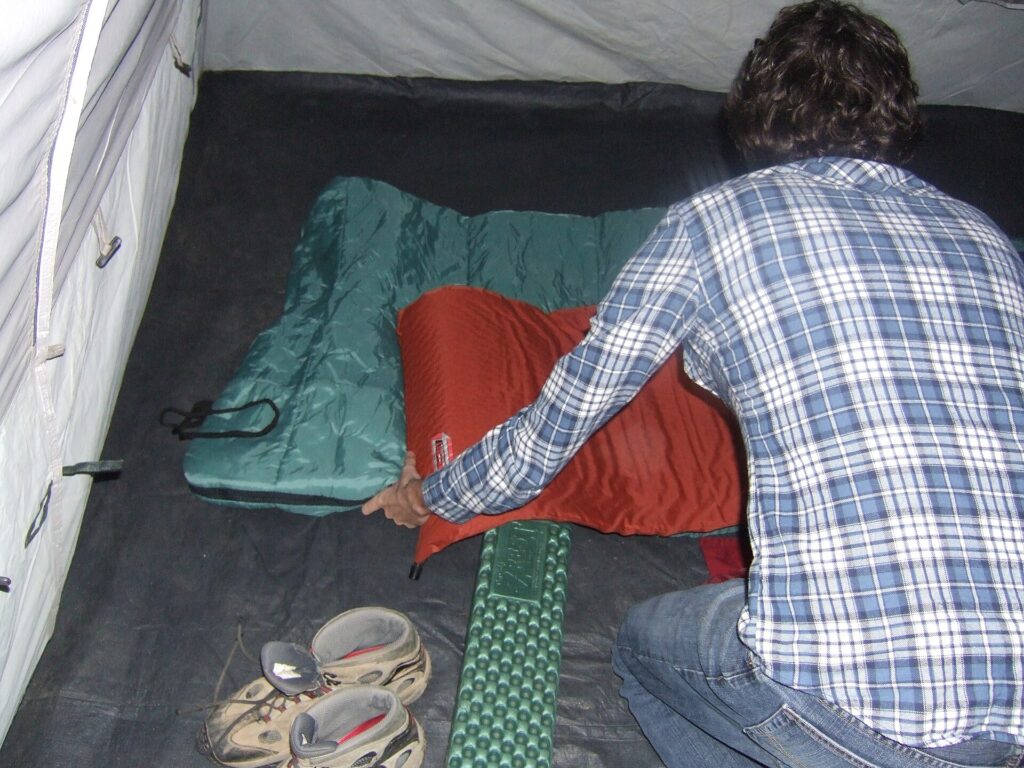
A useful property is that R-values stack when pads are layered: two pads rated R-2 and R-3 together give roughly R-5. That lets you build a winter system from a summer pad plus a closed-cell foam pad, which also doubles as a sit pad and a backup if your inflatable pad punctures. It also means a thin ultralight pad that is perfect in July can become part of a shoulder-season system rather than being replaced outright.
Do not underestimate the pad. A warm bag on a thin pad on cold ground is a cold night, because the insulation under your body is compressed by your weight and contributes little — the pad does that job. If you can only upgrade one part of your system, and you already own a reasonable bag, upgrade the pad first.
Putting the system together
Start with the coldest night you realistically expect, subtract 10–15°F, and buy a bag whose comfort rating meets that number. Match the pad to the same conditions using the bands above. Then think about the rest of the system: a sleeping bag liner adds a few degrees and keeps the bag cleaner; a tent that pitches taut keeps wind and condensation off the bag; and dry socks and a warm hat at night cost almost no weight. Cold sleepers should bias colder on both numbers — ratings describe an average sleeper, and nobody is exactly average.
Altitude and desert nights are where the system is tested hardest. Read our area guides for camping in Colorado, where altitude nights stay cold even in summer, and camping in Texas, including Big Bend and state parks, where desert temperature swings between day and night can be dramatic. Then use the sleeping bag calculator to check what rating your trip actually calls for.
What 35°F, 20°F, and 0°F Actually Buy
Price ranges below are planning estimates for typical retail bags, not quotes for a specific model. What changes as you pay more is mostly insulation quality, weight, and pack size — not the rating system itself.
Summer bags: comfort around 35°F to 50°F (planning estimate: $40 to $100)
Light, compact, and easy to carry. Best for warm-weather car camping and summer nights where lows stay above 45°F. They are a poor choice for spring or fall trips, where a single cold snap can ruin the night.
Three-season bags: comfort around 15°F to 30°F (planning estimate: $80 to $250)
The most versatile choice for most campers in the US, covering spring, summer, and fall in temperate regions. A comfort rating near 20°F handles the widest range of trips, and you can vent the bag on warm nights by unzipping it. If you buy only one bag, buy here.
Winter bags: comfort at 0°F or below (planning estimate: $200 to $500+)
Thick, heavy, and built for snow camping, late fall, and high altitude. Overkill for most beginners, but essential once lows drop below freezing regularly. Winter bags also demand a warmer sleeping pad, which adds to the real cost.
How to Choose Your Rating in 5 Steps
- Find your coldest expected night (5 minutes, easy). Check the forecast low for your exact campsite elevation, not the nearest town. Mountain sites can run 10°F to 15°F colder than the valley forecast. If you camp in shoulder seasons, use the record low for that month, not the average.
- Subtract a 10°F safety buffer (1 minute, easy). Lab ratings assume a dry bag at full loft, base layers, and a proper pad. Real nights are rarely ideal, so choose a comfort rating at least 10°F colder than your expected low. Cold sleepers should use a 15°F to 20°F buffer.
- Match the number to the right rating (2 minutes, easy). Compare comfort ratings to comfort ratings. If a bag only lists one temperature with no test standard, treat it as marketing, not measurement, and prefer a bag with published ISO 23537 numbers.
- Check the pad, not just the bag (5 minutes, easy). Bag insulation compresses under your body, so the ground steals heat all night. A summer pad under a winter bag still leaves you cold. For three-season camping, pair your bag with a pad rated around R-3 to R-4 (planning estimate: $50 to $150); for winter, look at R-5 and above.
- Decide your sleep style honestly (2 minutes, easy). If you are always the first to grab a blanket at home, you are a cold sleeper: shop by comfort and take the bigger buffer. If you kick covers off year-round, you can shop closer to the limit rating.
Gear and Materials List
- Sleeping bag with published ISO 23537 comfort and limit ratings
- Insulated sleeping pad matched to the season (R-value as above)
- Base layers for sleeping (dry, non-cotton)
- Sleeping bag liner (adds a few degrees of warmth and keeps the bag clean)
- Compression sack or stuff sack for packing
- Large storage sack for keeping the bag lofted at home
- Repair tape for small shell tears
7 Decision Factors, With What Each One Costs You
- Temperature rating. The single biggest warmth factor. Going one rating warmer typically adds $30 to $80 (planning estimate) and some weight — cheaper than a miserable night.
- Down vs. synthetic insulation. Down packs smaller and weighs less for the same warmth but loses insulation when wet and costs more. Synthetic insulates better when damp, dries faster, and is usually cheaper, but it is bulkier and heavier. Budget impact: synthetic often saves $50 to $150 (planning estimate) at the same rating.
- Shape. Mummy bags are the warmest per ounce because they hug the body and seal heat. Rectangular bags give room to move but leak more warmth. Semi-rectangular bags split the difference. Roomier shapes can cost you 5°F to 10°F of effective warmth at the same rating (planning estimate).
- Weight and packed size. Backpackers pay a premium to shave ounces; car campers do not need to. Ultralight down bags can cost twice a car-camping equivalent at the same rating (planning estimate).
- Shell and zipper details. Draft tubes, draft collars, and snag-free zippers stop heat leaking at the weak points. Skipping them can make a bag feel 5°F colder than its rating (planning estimate). These features usually add $10 to $40 (planning estimate).
- Fit. A bag that is too long leaves cold air pockets at your feet; one that is too tight compresses the insulation and makes cold spots. Try the stated height and shoulder girth against your own measurements before buying, since returns cost time and shipping.
- Care and lifespan. Down lasts longer if stored lofted and washed rarely; synthetic is more forgiving of compression and washing. A bag stored compressed in its stuff sack loses loft over months, which quietly erases warmth you paid for.
Common Mistakes
- Buying by the extreme rating. Extreme is a survival number. A bag “rated to -20°F” on its extreme figure may only be comfortable near 10°F.
- Comparing different numbers across brands. One brand’s headline 20°F may be a limit rating while another’s is a comfort rating. Compare the same figure, from the same standard.
- Forgetting the pad. The best bag in the world cannot insulate you from the ground. Budget for the pad as part of the sleep system, not an afterthought.
- Trusting daytime highs. Always plan around the nighttime low at your campsite elevation, then add the buffer.
- Storing the bag compressed. Keep it in a large breathable sack at home so the insulation stays lofted and warm.
- Skipping the test night. Try the bag in the backyard on a cool night before a real trip, so a fit or warmth problem shows up where you can fix it.
Safety: Cold Nights Are a Real Risk
Hypothermia begins when the body loses heat faster than it can produce it, and it can develop on nights well above freezing if you are wet, tired, or under-insulated. The National Park Service guidance on hypothermia stresses staying dry, eating enough, and getting out of the cold at the first signs of uncontrollable shivering, confusion, or clumsiness. If a companion shows those signs, get them into a dry, warm shelter, replace wet clothing, share body heat in a dry bag if needed, and seek medical help. Never plan a trip around the extreme rating of your bag: if the forecast low approaches your comfort rating, bring a warmer bag, a liner, or change your plans. For more on staying safe outside, see our essential camping skills guide and our beginner’s camping checklist.
Frequently asked questions
What temperature sleeping bag do I need for three-season camping?
A 20°F bag is the recurring three-season default. Buy on the EN/ISO comfort rating, and choose a bag rated 10–15°F colder than the lowest temperature you expect, to leave a margin for forecast error and cold sleepers.
What does pad R-value mean?
R-value measures insulation from the ground: higher is warmer. Around 1–2 suits summer, 3–4 suits three-season use, and 5+ suits below freezing and snow. R-values stack when you layer two pads.
Is down or synthetic better?
Down is lighter and more packable for the same warmth in dry conditions. Synthetic insulates better when wet, dries faster, and usually costs less. Choose based on how wet your trips are, not on marketing alone.
Why am I cold even in a warm-rated bag?
Most often, the pad is the problem: compressed bag insulation under your body does little, so ground cold comes straight through a thin pad. Check your pad’s R-value against the conditions before blaming the bag.
Should I buy a bag rated exactly for my expected low?
No. Buy a bag whose comfort rating is at least 10°F colder than the coldest night you expect, and 15°F to 20°F colder if you sleep cold. You can always vent a warm bag; you cannot add insulation to a cold one.
What temperature sleeping bag do beginners need most?
A three-season bag with a comfort rating near 20°F covers spring, summer, and fall camping for most US campers. It is the best single-bag choice before you specialize.
Do sleeping bag liners really add warmth?
Yes, a liner typically adds a few degrees of warmth, protects the bag from body oils, and is far cheaper than a second bag. Treat it as a booster, not a rescue plan for a badly under-rated bag.
Are expensive bags warmer than cheap bags at the same rating?
At the same tested comfort rating, warmth is comparable. What extra money buys is lower weight, smaller packed size, better materials, and features like draft collars — not a different rating scale.
Warm nights start with the right pair — try the Camp & Trail Guide tools hub for the sleeping bag calculator and the rest of our planning tools.