
By Camp & Trail Guide
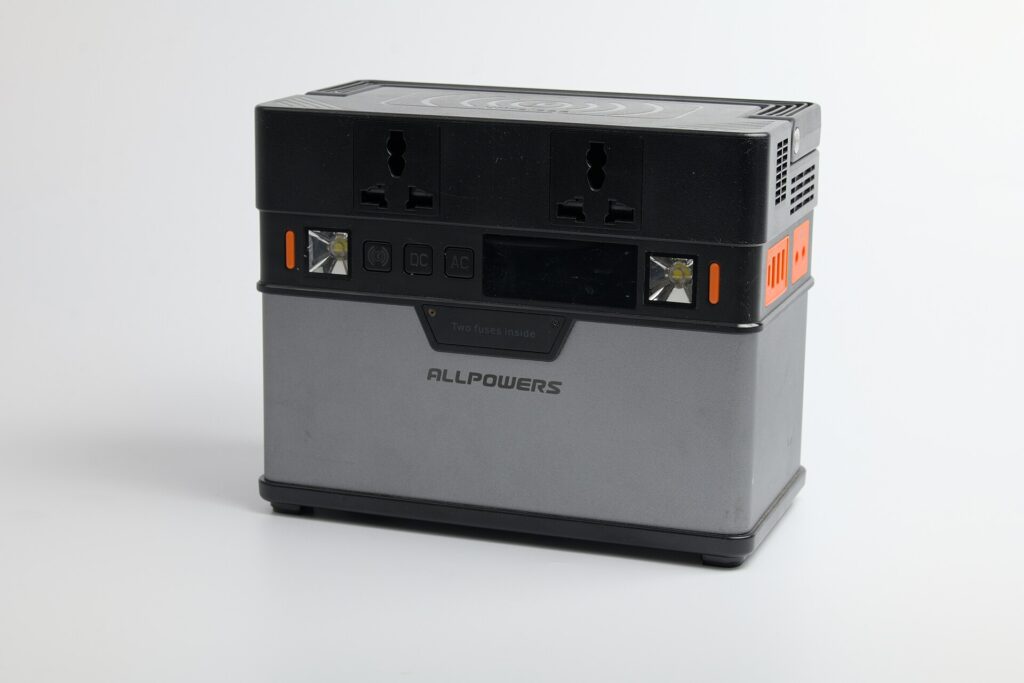
A portable power station is a rechargeable battery in a box, with outlets for phones, laptops, lights, a 12V fridge, and, on larger RV models, a 30-amp RV plug. It is not a generator: there is no fuel engine, no exhaust, and no noise from a motor. For campers, the appeal is simple — quiet power at a campsite, in a van, or at a dispersed site where hookups do not exist. The hard part is sizing. Buy too small and the fridge dies on night two. Buy far too large and you are hauling weight and spending money you did not need to spend.
Check the current spec before you buy: battery capacities, outlet layouts, charging speeds, and prices move as manufacturers revise models. Treat every figure in this guide as a research-based starting point, and confirm the current manufacturer spec sheet for the exact model you are considering.
Why LiFePO4 is now the standard
Recent 2026 buying guides converge on lithium iron phosphate — LiFePO4 — as the standard battery chemistry for portable power stations. The reason is cycle life: LiFePO4 stations are commonly rated for 3,000–4,000 charge cycles, compared with 500–1,000 cycles for older lithium-ion designs. A cycle is one full charge and discharge, so a higher cycle count means the battery should hold useful capacity through many more trips before it degrades noticeably.
That matters most if you camp often, live part-time in a van, or use the station as home backup between trips. An occasional weekend camper may never notice the difference. A frequent boondocker will. Cycle ratings are manufacturer figures, measured under laboratory conditions, so real-world life will vary with heat, depth of discharge, and how the unit is stored — but the gap between LiFePO4 and older lithium-ion is large enough that chemistry is the first filter to apply when you shortlist models.
Sizing by use: start with watt-hours
Watt-hours (Wh) measure total energy stored. A 500 Wh station can deliver 500 watts for one hour, or 50 watts for ten hours, before losses. Sizing by use, as the 2026 guides frame it, looks like this:
| Trip type | Typical size | What it runs |
|---|---|---|
| Overnight / phone and CPAP | Around 500 Wh | Phones, lights, and a CPAP overnight |
| Long weekend, car or RV site | Around 1,500 Wh | A 12V fridge plus laptops over a long weekend |
| Van life / home backup | 2,000+ Wh | Longer off-grid stays and backup power at home |
These are planning bands, not promises. A fridge in desert heat draws more than the same fridge in cool mountain air. A laptop used for video editing draws more than one used for email. Add up the watt draw of your own gear, multiply by the hours you will run each item, and compare that daily total with the station’s usable capacity. If your daily total is close to the station’s full capacity, you need either a bigger station or a way to recharge during the trip — usually solar panels.
RV picks: look for a native TT-30R outlet
For RV use, the outlet matters as much as the battery. RV-specific picks need a native TT-30R 30-amp outlet — the standard RV shore-power plug — so you can plug the RV in directly without an awkward adapter chain. The report’s example is the EcoFlow DELTA Pro 3, at 4,096 Wh, which illustrates the large-capacity, RV-ready end of the market. Smaller stations without a TT-30R can still charge phones and run a fridge, but they are not a drop-in RV shore-power replacement.
Also check the station’s AC output in watts, not just its Wh capacity. A station can hold plenty of energy yet still trip if you switch on a device that draws more watts at once than its inverter can supply. Air conditioners, microwaves, and electric kettles are the usual problem loads; check their rated watts against the station’s rated output before assuming they will run.
Solar charging and the Starlink question
Most large stations accept solar input, which turns a finite battery into a renewable one — as long as the sun cooperates. In the sunny Southwest, solar recharge is a realistic daily routine. Under tree cover, in winter, or in the Pacific Northwest, it is much slower, and you should plan for that shortfall rather than discover it at a shaded site. Panel wattage, sun hours, and shade all change the result, so use a calculator rather than guessing.
One named sub-use in the 2026 guides is Starlink, with a draw of around 24W in one guide. At that draw, Starlink alone uses roughly 24 Wh per hour — a small but constant load that adds up across a full day of remote work. If you plan to work from camp, include Starlink, your laptop, and your phone in the daily total, and size solar to replace that total, not just to top up the battery.
What to check before you buy
- Chemistry: LiFePO4 for the longest cycle life.
- Capacity in Wh: matched to your daily use, with a margin for heat and inefficiency.
- Output in watts: enough for your largest single device, not just your total energy.
- Outlets: TT-30R for RV shore power; enough USB and 12V ports for everything else.
- Recharging: solar input wattage, wall-charging time, and whether it can charge from your vehicle while driving.
- Weight and size: a 2,000+ Wh station is heavy. Make sure you can lift it into the truck or trailer.
For boondocking and dispersed camping, pair this guide with our area guides for camping in Utah’s Mighty Five and Moab and camping in Texas, including Big Bend and state parks, where hookups are often absent and power planning is part of the trip. Then run your numbers through the RV solar calculator to size solar and battery for your own daily watt-hours, sun hours, and days of autonomy.
Frequently asked questions
How many watt-hours do I need for camping?
As a starting band, around 500 Wh covers phones and a CPAP overnight, around 1,500 Wh covers a 12V fridge plus laptops over a long weekend, and 2,000+ Wh suits van life or home backup. Add up your own gear’s draw and hours to replace these bands with a real number.
Is LiFePO4 worth it over older lithium-ion?
For frequent use, yes: LiFePO4 is rated for 3,000–4,000 cycles versus 500–1,000 for older lithium-ion, so it should last through many more trips. For rare weekend use, the difference matters less.
Can a portable power station run my RV air conditioner?
Only if the station’s AC output in watts covers the air conditioner’s draw, including its startup surge, and its Wh capacity covers the runtime you want. Check both numbers on the manufacturer spec sheet; capacity alone is not enough.
Do I need solar panels with a power station?
For a single overnight, usually not. For multi-day boondocking, solar is what keeps the station from running flat. Size panels to replace your daily use, and expect slower charging in shade or winter.
Size your setup properly before you buy — try the Camp & Trail Guide tools hub for the RV solar calculator and the rest of our trip-planning tools.